Buscar

The New York Street

Un blog lleno de historias

Categoría

Perú

Antojito de arroz zambito

«En el versículo 7, el Capitán Cavernícola dice que no se puede comer pan con mango». Eso recitaba el cuatrero barato. Medias de nylon con cartelito de Koyama, bluejeans roídos, tabas de remate de Superepsa.

En esa época no existían aún las combis y los carros viejos como el mío costaban casi 10 mil dólares y llevaban en alguna parte de la guantera su sello: Ensamblado en Perú.

Puse el radio en Mar, la que siempre escucho, la voz del Ronco me hizo acordar que la flaca me estaba esperando con su uniforme de colegiala. Lamenté no haber recogido los papuleles que me atoré el otro día con ella. Así nos hubiéramos divertido más. Pero no todo es perfecto. Al fin y al cabo estamos en Lima.

«Siéntate perdedor» me dijo el cuatrero barato. De nada sirvió que volviera a mirar con desprecio sus medias Koyama. Se me empezó a contagiar la desgracia y hasta me acordé que alguna vez, paseando por el Jirón antes que lo transformasen en supermercado, también compré algunas cositas en el Tía frente a la Iglesia.

El cuatrero barato es el mejor peluquero de Lince. Entre cortada y cortada, como para inspirarse, se iba detrás de la cortina y se metía su traguito de pisco. De pico. Creo que con dos clientes se acababa la botella el chino. Después cerraba el local y se iba a chupar.

«Hay que catequizar a estos mierdas» dijo la pelada. Y le zampó una bofetada tecnológica a la perra esa de Patricia. Me acuerdo que me sentaba con ella en el asiento de atrás, camino al colegio. Ya tenía las piernas regordetas. No me extrañaría que se la hayan comido las várices.

«Lima tiene demasiada leche condensada» Facilito se la lleva este huevón. Nunca supe de donde sacaba sus frases célebres, pero se podía pasar toda la tarde llenándote la cabeza de esa basura. Te ibas con menos pelo (corte alemán) pero con una tonelada de carga radioactiva en el cerebro y luego no sabías qué hacer con ella.

Respiré hondo. Había cada vez más humo en las calles de Lima. Qué bueno es vivir a cuatro pasos de la peluquería. Abro la puerta de mi casa. Me acaban de dar la copia de las llaves. Basta de mostrarle el aliento a mi mamá. Basta del «¿has tomado?». Si ya sabe que sólo a eso voy. A chupar. Para qué molestarse en constatar que el aliento siempre me apestará a alcohol.

Retiro lo dicho. No sólo voy a chupar. Me encantaría agarrarme a Silvana, pero por alguna razón todo lo que digo cuando estoy frente a ella siempre está mal. Mi adolescencia siempre ha sido una cagada. Demasiadas ideas condensadas. Demasiada leche en bolsa. El cuatrero miserable tiene la razón. Nunca me he divertido tanto como ahora, a la distancia. Cuando puedo imaginarme a Lima en llamas, su raquítica niebla cayendo pesada sobre los edificios de sus acantilados de pesadilla. Pensar que alguna vez caían gotas. En mi Toyota de 10,000 dólares. Recuerdo haber mirado a los bañistas de la Costa Verde duchándose bajo las cascaditas.

«Esa es tu Lima que se fue». Y sí pues. ¿Qué están chupando? ¿Sirve de algo preguntar? Igual me lo voy a empujar. Bonito, bonito, todo para adentro. Como la siniestra mirada con la que reventábamos la pelota contra la puerta de la casa. Lo ideal era hacer mucha bulla. Mi barrio era clasemediero. La Molina sólo el nombre, un sitio bastante aburrido. Desde que se separó el grupito que jugaba al fútbol en uno de los pedazos del parque, desde que se fue Patricia y sus caramelos con sabor a Coca Cola. Creo que ella debió de haber sido la protagonista de mis primeros sueños eróticos.

¿Por qué cuando la penetro no pienso en ella? ¿Por qué ya no me interesa para nada si Perú va a un mundial? ¿Por qué me cuesta fijarme en un tiempo determinado? ¿Por qué no recuerdo el nombre de la perrita que conocí en el bus a Quito? ¿Por qué no me basta mirar sino que tengo que juzgar?

Sé que al cuatrero enamorado le daría demasiada risa todo lo que he escrito. Sé que a la pelada le temblaría la mano si tuviera que darme una bofetada. No podría. Sé que en algún rincón de su inconsciencia sonreiría ante tanta confesión, ante tanta miseria.

No me había perdido montando la bicicleta. Aún recuerdo el dolor de aquellas primeras caídas, de aquellas silenciosas rondas, de su perfume de precio módico (no tan barato) quejándose de que le estaba poniendo la cabeza encima de su chuchita. Nunca me voy a correr como me corrí esa noche borracho sobre su cuerpo ardiendo. Nunca voy a besar a nadie como besaba sus labios en esos tubos inmensos de desagüe. La buena notica es que parece que nunca voy a estar tan solo como cuando murmuraba su nombre y lloraba.

¿Por qué me vienen estas memorias? ¿Por que tengo antojo de arroz zambito?

¡Finalista del Copé de cuento!

La angustia de la espera terminó.

Hoy publicaron la lista de los ganadores de la bienal de cuento Copé 2006. Me da gusto comunicarles que entre 1, 607 participantes mi cuento Visitando la playa, -sobre una visita ficcionada a los recuerdos de mi playa de adolescencia, Silaca, en la costa de Arequipa-, quedó elegido entre los 12 finalistas y será publicado en el libro con los cuentos ganadores.

No hay dinero en efectivo para los finalistas pero sí un diploma, creo.

Este es el comunicado oficial publicado hoy en la página web de Petroperú:

El Jurado Calificador de la XIV Bienal de Cuento “Premio Copé 2006”, que se reunió en las instalaciones de Petróleos del Perú la tarde del martes 27 de marzo, seleccionó, entre los 1,607 obras participantes, 15 trabajos finalistas, entre los cuales el cuento «El mestizo de las Alpujarras» obtuvo el Premio Copé de Oro. Tras abrir el sobre en cuya parte exterior se consignó el seudónimo “Blas Valera”, se determinó que el ganador fue Selenco Vega, que se hará acreedor a 5.000 dólares americanos.

Se adjunta la relación total de ganadores:

El Jurado Calificador estuvo integrado por Pedro Cateriano, en representación de Petroperú; Carlos Eduardo Zavaleta, por la Academia Peruana de la Lengua; Eduardo Hopkins, por la Pontificia Universidad Católica del Perú; Antonio Gálvez Ronceros, por la Universidad Nacional Mayor de San Marcos; y Manuel López Rodríguez, por el Instituto Nacional de Cultura.

De acuerdo con las bases del concurso, Selenco Vega, Sergio Galarza y Alina Gadea verán sus cuentos impresos en la próxima publicación de Ediciones Copé –“El mestizo de las Alpujarras y los cuentos ganadores y finalistas de la XIV Bienal de Cuento Premio Copé 2006”–, en la que participarán también Abel Aguilar Urdanivia, Jorge Emilio Harten Rodríguez-Larraín, Johnny Barbieri, Juan Carlos Bondy Esquerre, Sebastián Esponda, Gabriela Caballero Delgado, Fabrizio Tealdo Zazzali, Ladislao Plasencki, Arturo Mosqueira Cornejo, Néstor Vicente Sobero Rusca, Ulises Gonzales García y Víctor Borrero Vargas, quienes fueron seleccionados como finalistas.

San Isidro, 29 de marzo de 2007

Departamento Relaciones Corporativas

Rupac.Taking Paths


Dangling my feet from the top of the mountain, I wondered how my life was going to be back in the city.

There is a certain magic in the way that Rupac looks at night. Lost in the middle of the jungle, its gigantic stones looking to the East, it seems to be the perfect place where one could stay and nobody would dare to tell you ever to leave.

My brothers and friends are gathered around the bonfire we made inside one of the ancient stone houses. I have tried to walk a hundred feet away, but it feels dangerous among the vivid sounds of insects, a distant brook, and the moving leaves of the surrounding forest. After dangling my feet over the abyss for a few minutes, I walk back.

The morning after, I was among my brothers and my friends descending the path to the small town of Pampas, leaving behind the ancient stones of the perpendicular city that touches the clouds. The soles of my muddy boots were gone, and I preferred to descend bare foot. It was a three mile path beside a waterfall that transformed the light into a luminous rainbow.

Four hours later, I throw myself over my bed and tried to summarize the trip in my school notebook.

I have discovered this morning, in a forgotten drawer of my Lima’s bedroom, the brief sentence that I wrote about that weekend on a piece of yellowish paper: «We left to see the light and through the light to guess who we are.»

All the pictures that I took of that trip, including the zoom to a condor standing over a stone and gazing into the curious lens of my Canon camera, are lost.

But my memory is rigid. Among the ruins of Rupac, running down the muddy path towards Pampas, I discovered a piece of an eternal truth.

My brothers know how difficult it is for me to lie. Everytime, I prefer lying to myself.

Written after reading Henry James’ description of the horrors of WWI, and the execution of Nafisi’s student, Razieh, by the Revolutionary Islamic Republic of Iran, in the book Reading Lolita in Tehran

The Grocery Store


Grandpa walked every morning, by the olive tress, on the dusty road from the main plaza towards the grocery store of his best friend: Manu.

Once, when I was 7 years old, I went with him to the store. Out of curiosity I asked him who was the oldest one. Grandpa lighted his cigarette, puffed once, smiled looking to the roof and never answered. I did not ask him again.

Grandpa died when I was 19. At that time he had forgot almost everything, he passed the whole day walking around our house in the capital and spitting over the floors just waxed. One day he opened the door and started to walk away. He walked a long distance before we could find him. I asked where he was going and he barked back that he was going towards the mountains «to kill Indians». His eyes were red and I could feel that he was going to spit to my face if I dared to oppose him.

When I was a kid I liked to run from the old house, bare foot, towards the grocery store. There were always people around the streets that knew me, old aunts, uncles, young cousins. The last time that I went to the town I was 30. While driving around the main plaza I could not recognize anybody sat down on the benches there.

A pinky-cheeks guy of my age waved hello to me. He asked for my family. «Everybody moved to Lima,» I said, from my almost brand new 4-wheel drive black SUV. He told me that he married with the daughter of the school’s director and worked the olives of her family. I said bye and drove towards Manu’s store.

Manu was still there, as old as the things that he displayed on the shelves of his store. He did not recognized me at first. When he did, he seemed to be happy to know that my family was surviving in the capital.
-Who was the oldest of you Manu? I asked before leaving. It was the kind of stupid question that you ask because you don`t have anything else to say.
-Your grandpa did not tell you? We were born the same day. He smiled and turned around to look for some invisible cigarettes.

I smiled back. I knew he was lying.

Tierra de Animales

Y el bang
y el bum
y los vidrios cayendo como gritos desde el Infierno
«¿Están todos bien?»
En la salida del cine, ¿cuánto me cobras hasta?»
¿No lo sabían?
Parece que es Sendero
«La nacionalización del sistema financiero»
Eso es lo que tenía que hacer este huevón
Y en el kiosko
¿Quién te ha dicho que no sabe nada? Es ingeniero
Anoche entró Sendero
Sendero ha tomado la Embajada.
¡Vamos a matarte Julio Segura!
Y en la noche, después de la cena se sienta Julia
y nos cuenta.
No quiero eso, sácate eso. No quiero eso.
¿Cuanto me cobras por enseñarme la chucha?
Brummmm, ¿Están todos bien?
Ya nos malograste el paseo.
La risa caverníiicola
Es solo un momento chicos ¿Nunca has posado para publicidad?
¿Nunca te la han chupado?
Acá tenemos con nosotros a Bibi Gaitán
¡Bibiiii! ¡Bibiiii! El gran Wilhelm Granverguer.
Para o te disparo conchatumadre.
¿Jefe y la rifa?
Si pues señora, pero..caliente, caliente.
Estuve asi de enamorarme de ti.
Tu y yo solo podemos ser amigos.
¿Pero dime…a quién quisiste más?
¡Ya están en Chosica!
Allá por el cerro, las veredas son así de altas.
Camino a Cieneguilla
No pense que serías capaz de hacerme algo así.
A veinticinco pues mamita
Vamonos pues
Siempre llegamos tarde a todos lados
¡Muchacho!
Es una maravilla.
Y el caballo camina sin riendas
entro al pueblo de nuevo y escucho las risas
«Te voy a enseñar a silbar con los dedos»
Debajo del agua, el tacto de sus senos.
He mandado a todos al pozo
Quisiera que fuera una declaración de amor…Yolanda, Yolanda
en la hora púrpura, estacionados en San Borja
Este es el último día de colegio.
number nine, number nine, number nine.
Quisiera seguir asi, maquinándome, maquinándome
Y el tráfico. Échale un fósforo.
Es lo mejor que podías haber hecho. De todos modos te van
a despedir.
Estatización del sistema financiero. Eso es lo que tenía que hacer
este huevón.
Es ingeniero.
Por favor, que no nos metan más goles.
Eres un maricón.
Las voces del colegio,
el patio de quinto.
Humillación al ritmo del cha cha cha.
Eso es un brassiere, su brassiere, su falda
Bésame en silencio.
Soy de Ventanas. «Eres el chico más lindo»
No tienes corazón.
«Helados Glacial Helados»

Es esa arena mojada que se pega entre los dedos
en la playa,
es la arena que se mete a la boca,
es la sal.
¿Qué vas a hacer?¿Acaso se la puedes presentar a tus amigos?

Estoy como cuete. Como cuete quemado.
Vamonos al monte
a matar indios.
¡La peineta! ¿Dónde está mi peineta?

Siempre pasa, es una crisis de fe pasajera.
A todos nos pasa.
Y gritando, y gritando
Y en la soledad de tu cuarto
«¿Cómo te masturbas? ¡Mastúrbame así!»

¿Alguna vez se ha masturbado?
¿Se ha corrido la paja?

En la soledad, sus labios. no nos han visto.
Entre las frutas, toco tus labios.
en silencio, toco tus labios.
Detrás de la ropa la mirada de una tía que nos mira

¡Te dije que no!
Yo que voy a saber
¡Tú no te das cuenta de nada!
De nada, de nada.

En la calle, estrellando el balón contra la puerta
Empiezo a ver doble, las luces, no quiero pero no puedo.
Lleva la cuenta en el reloj de pulsera. Digital.
Déjame jugar
¿Cómo se llama eso?

¿De verdad irías conmigo a un hostal?

¡Bibiiii!
El calor de sus senos aún lo recuerdo. No hay nada más.
Es sólo el calor, como un flach.
Se ríe.
«Ella lo quiere joven, pero me ha dicho
Cómo se yo que él me quiere?
Me asomé por la cerradura y los vì.
Ella se la estaba chupando.
A ella le gustaba»
¿Cómo van a ser esos drogadictos mejores que usted, joven?

Su voz.
¿Alguna vez te has enamorado?
Nunca he besado a nadie antes.
Primo.

Su piel era tan suave. En la plaza de Barranco.
La piel de su rostro era tan suave.
Esas perlas aún son sus ojos.
Y su aliento era tan fuerte.
Y hubiera saltado con ella, esa noche.
Y muchas noches más
De villancicos.

Nos fuimos al mercado a caminar
y le compré un cactus pequeñito.
Me gustaba sentarme a verla dormir.
Se lo tragó con zapatos y todo.
Mi corazón.

Dormir en la calle no es buena idea.
Hace mucho frío en la estación,
el taxista sigue por la ruta al lado del terminal.
«Si hubiera sabido que no eran sus amigos yo no los llevaba…»

Ring ring. En el tren se mira mejor la soledad.
¿Has viajado solito?
Todos los que no son de izquierda son unos hijos de puta
Brincadeira peruano
Déjame que te presente a las Petunias.

Me voy a trabajar en Chimbote
Estuve a punto de decirte que sí.
Vas a tener dos hijos y una hija.
Tambiéeen vieneee.
«Atrás de este cerro está la Musa»
Acá tienes cien soles: Que tu empleada me enseñe las tetas.

Grita, grita para que se te vaya el dolor.

Mira, mira al frente.
No se ve nada.

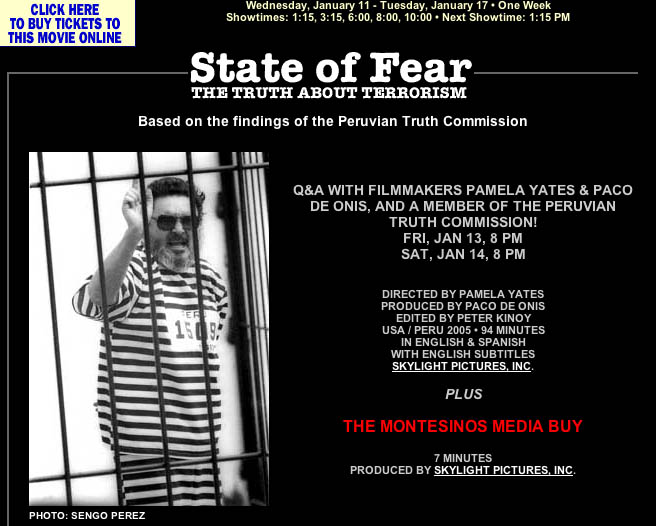
Estado de miedo

Es común llegar al Film Forum de Nueva York y encontrar una larga cola para entrar. Este es uno de los pocos cines en NY que lleva a cabo ciclos de cine de autor y documentales. Sin embargo, no es común que en una semana se estrenen dos documentales con temas peruanos (State of Fear y The Fall of Fujimori). Tampoco es común que uno encuentre una larga cola para entrar y otra larga cola para comprar entradas, además ya agotadas. Esto es lo que pasó el viernes en la noche con State of Fear de la directora Pamela Yates. Es un documental sobre la historia de la lucha contra el terrorismo en el Perú. A los neoyorquinos les interesa el paralelo entre la guerra contra el terror de Fujimori y la guerra contra el terror de Bush. Los jueces sin rostro, las torturas, la intromisión en la vida privada y el acceso a información confidencial; son temas de discusión en el parlamento de Washington. A quienes siguen ciegamente a Bush no les importa perder ciertas libertades si se trata de luchar contra ese «enemigo oculto». Pero algunos temen que se utilice el «estado de miedo» para restringir derechos ganados tras muchos años de lucha. El caso de Fujimori, con las tremendas diferencias entre ambas sociedades, es una prueba de lo peligroso que resulta entregarle el control total al estado, desmantelando a las instituciones encargadas de fiscalizarlo. Regresé el sábado, con menos cola. Verlo fue una experiencia muy útil. Garabateé algunas ideas y reflexiones al regresar a casa. Son estas:

A un documental sobre los años del terrorismo en el Perú se le debe pedir, sobre todo, que diga la verdad. Pero cada pueblo maneja distintas verdades y los problemas empiezan cuando las diversas facciones involucradas en la historia intentan asegurar que sea su verdad la que prevalezca. El comisionado Carlos Iván Degregori, se puede percibir que escogiendo con pinzas sus palabras, describe su verdad. Posiblemente sea la verdad a la que han llegado muchos de los que promovieron las investigaciones de la Comisión de la Verdad: Sendero Luminoso organizó un movimiento subversivo de características mesiánicas que fue impuesto en ciertas comunidades campesinas de Ayacucho y que creció en las zonas rurales a través del convencimiento pero también a través del miedo. La respuesta del estado peruano fue pésimamente planificada. El accionar de los militares, que ni siquiera hablaban quechua, empeoró la situación de los pobladores. Se mató a muchos inocentes. Esto retardó una victoria militar, inevitable por el estilo tiránico de Sendero y por la mejor preparación de las fuerzas armadas. Debido a las deserciones de los cuadros de Sendero, desengañados y aterrorizados, Abimael Guzmán precipitó su estrategia de terror en la capital. En Lima era más fácil que los cuadros senderistas trabajaran sin ser descubiertos. Algunos inocentes entraron a prisión debido a la indiscriminada respuesta del ejército y al salir terminaron como senderistas ya que las prisiones de Lima se habían transformado en centros de adoctrinamiento.

Fue el trabajo de inteligencia, organizado desde la policía, el que permitió capturar a Abimael. Al capturarlo su movimiento mesiánico se desmoronó rápidamente. Alberto Fujimori, hasta ese momento un convencido que la victoria contra el terrorismo pasaba por una solución militar, capitalizó la derrota de Sendero para conseguir un segundo mandato, pero luego, ya estando Sendero derrotado, siguió utilizando el factor del miedo para obtener un tercer mandato inconstitucional.

Una de las comisionadas, Beatriz Alva Hart, representa –en este documental- a la clase social a la que yo pertenezco en el Perú. Ella nació y vivió en una clase media alta. Ella vivió durante los años de Belaúnde y de Alan García ajena a las masacres cometidas por Sendero y las Fuerzas Armadas en la sierra peruana. Ella pertenece a una clase social, que a lo largo de la historia del Perú, ha considerado a los indios peruanos como ignorantes y brutos y que con cierto cinismo ha aprovechado esta situación para poder tener, entre otras cosas, servidumbre barata. El fenómeno es más notorio en Lima, donde está concentrada la mayor parte de la riqueza nacional, pero es un proceso lamentable, que se reproduce en otras ciudades importantes, en capitales de provincias, de distrito y en los pueblos, donde los descendientes de las familias más antiguas autentificaban su superioridad y su derecho a ser dueños de la mayor parte de las tierras de la comunidad mediante la discriminación racial.

El tema racial es uno de los problemas que el Perú debe resolver si realmente pretende construir una socidad fuerte y justa. El Perú son varios países, geográficamente ya dividido, pero la diferencia abismal en el nivel educativo de una y otra clase social hace inevitable que se abra una brecha entre la clase social alta, media y las clases sociales más bajas. Los indios siempre estuvieron, y siguen aún, en esas clases sociales más bajas.

Me parece aborrecible que algunos simpatizantes de los subversivos, pretendan facilitar la libertad de los líderes de Sendero condenados y sentenciados a cadena perpetua. Pero al mismo tiempo entiendo la premura por establecer una Comisión de este tipo en un país donde el fenómeno terrorista puede repetirse en cualquier momento.

Es muy importante saber lo que pasó y cómo pasó para que no vuelva a suceder. Y, si se repitiera, para que los peruanos evitemos cometer los mismos errores. Si la derrota de Sendero demoró tanto tiempo, no fue por el fortalecimiento del aparato senderista sino por la falta de inteligencia y por la respuesta desorganizada de los distintos gobiernos encargados de la lucha anti subversiva. De 1993 al año 2000, apenas derrotado Sendero, se debió empezar a reconstruir el sistema democrático y no a desmantelarlo para perpetuar a un caudillo.

Por último, los siete minutos finales del documental, son los vladivideos en los que se muestra a los directores de Canal 5, 4, 9 y CMN, recibiendo millones de dólares de Montesinos. Para que no nos olvidemos los peruanos que lo que vimos y escuchamos en la televisión entre 1990 y el 2000 fue lo que Montesinos quiso que veamos. Para que no nos olvidemos que en una democracia es importante contar con herramientas para controlar a los que tienen el poder en las manos. Para que no nos olvidemos que cuando todo el poder está en manos de una sola persona siempre hay otras que tienen abusos que denunciar y que no pueden ser escuchadas.

6 de marzo: Breves episodios de la vida de Ulises


Robert Carling me ha pedido una bio, es decir un resumen de mi vida, con el cual puede hacerme la carta para el programaa del master.
La he acabado el lunes, pero dado que la he empezado hoy, y que considero impotante que figure en mi diario, la voy a adjuntar. La foto es de Yauca, me hubiera gustado colocar una de Jaqui o de Anqui, pero lamentablemente no las tengo scaneadas y esto es lo mejor que pude encontrar en la web. Aqui va el texto completo de la carta:

Robert:

Im not completely sure if this is really what you wanted when you told me about giving you more details of my life. I hope it is enough. Also I’m sending you a copy of my resume.
Thanks a lot,

Ulises

I was born in 1972, in Lima, Peru. My parents, come from families from the south of the country, he, Jorge, is an engineer and she, Tula, is a psychologist. My dad’s father, Bernardino, was born in Cuzco, a very poor childhood, never finished high school but got a job as a teenager in a textile factory and became an expert, later installing whole textile factories in other peruvian cities, Santiago de Chile, and Montevideo, Uruguay.

My grandmother, Consuelo, was the seventh daughter of a small store’s owner in Paita, a town on the north coast. Next to Paita was Talara, center of the petroleum exploration at that time.

«A kiss for me», was the first English sentence she heard in his life, from a young American employee. She told me that laughing. One of her sisters married an American engineer, they left Paita and started a family in Fairbanks, Alaska.

My mom’s parents were born in a nice quiet nice town in the southern department of Arequipa, at the lap of an arid mountain, and less than one hour driving from the sea.

They paid for the education of their 4 daughters and 2 sons, with the management of a thin but fertile piece of land they inherited. Anqui was the name of the place, –next to a river that became dry during the winter but carried a lot of water every summer, coming from the top of the Andean mountains, –. There, my grandfather grew fruits –pomegranates, pears, figs, custard apples–; cotton, grapes and, mainly: olive trees.

Most of the old families in town, owned olive trees, planted first by the first Spaniards many centuries ago. Town people nicknamed olives «the black gold», and sometimes these trees were the source of small fortunes.

My grandfather also got to own almost hundred cows, and liked to milk them at dawn when his grandsons were visiting the farm during school vacations.

I can close my eyes now and recall, still fresh on my mind, the images of those far away days and the tender smell of the earth and the trees during those mornings. And can see him, always serious, handing me a big white ceramic mug, full of hot, foamy milk…

Bernardino met Consuelo while she was visiting some relatives in Lima and he was in a business trip. They established there, married soon after and had two sons: Jorge, my father, and Ricardo, a teacher who in his mid 30’s decided to be a priest and was ordained by the Pope, John Paul II during his visit in 1982.

My father, who lived with his family for 10 years in Santiago de Chile,–were Bernardino was sent to build a textile factory–, studied Civil Engineering when he came back to Peru, and, soon after finishing college, married my mother, who he dated during 8 years.

They had 2 sons and one younger daughter. I was born in November 1972, my brother Nicholas, 11 months later; and my sister, Carolina, in 1977. The three of us attended the same school, a middle class private catholic school, at 10-minute-driving distance from our house.

At my 10th birthday, a very close friend of mine, gave me a gift that changed my life: The book was A 15-year-old Captain by Jules Verne. I was instantly obsessed by the idea of writing my own book. Those days I decided that I wanted to be a writer. The gift for my 11th birthday was an old Underwood typing machine. Using that, I wrote a lot of small stories, more or less in the style of Jules Verne, and I helped my father typing his works for the bank, a State-owned one, where he worked for almost 15 years.

(At the beginning of the 90’s, my father was fired from the bank where he worked without any right to an economical compensation or insurance. After a decade of disastrous populism in the country, started 10 years of savage liberalism were most of the State-owned enterprises were sold or shut down.)

Was in 1987, that I read during a night, with awe A Hundred Years of Solitude , and started to write some stories copying his style, by that time I also was fascinated by the reading of The Time of the Hero by Mario Vargas Llosa, and A World for Julius by Alfredo Bryce. I started to enjoy reading all the novels I could get from these writers. Also, I read a book that was one of my greatest inspiration as a teenager: The Steppenwolf by Herman Hesse.

Other ideas than writing were taking my time. I love drawing as much as writing stories. I started to publish a fanzine that lasted my three last years in high school. I filled the pages with caricatures of teachers and stories I made up about them during incredible events.

(In one of those, the most celebrated by my mates, our school had been taken by the Tupac Amaru guerrilla, kind of popular at that time. In the story some of the teachers were taken hostages and forced to work doing humiliating tasks to support the revolution at the school. I almost was expelled from high school because of that, and other stories that some teachers considered offensive.)

Finishing high school I wanted to be a writer but my father didn’t like the idea, And I wasn’t sure either if I could make a living with it. He wanted me to become a lawyer, the closet career he imagined to Literature, and one with I could have made decent money. I tried to convince myself that I could became a lawyer, but after listening an introductory class to Law school I decided that didn’t like the idea of becoming a lawyer, at all.

So, I proposed my parents to study Mass Communications, thinking that I could combine my writing with my drawing skills and become a creative director for an advertising company , (becoming a journalist or writing scripts for movies was a better idea but I couldn’t tell that to my father at that time)

My other big passion, that wake up stronger as I finished to read The Steppenwolf, was: traveling.

My parents never had enough money to travel abroad (we were 5!) and that was, by that time, one of my personal biggest frustrations.

In 1992 my father, because of my good grades gave me some money to visit my best friend who was living in Washington. His idea was that visiting the United States during the summer I could improve my English. I convinced him that a trip through South America, by bus from Peru to Argentina was a much better idea. (I loved secretly the idea of going to Rio de Janeiro, but he didn’t.)

I was 19 year old, when I started my first big trip by bus, I went to Chile, Argentina and, counting with the secret approval from my mother, to Brazil. Traveling by myself during 2 months, I visited Buenos Aires, Santiago, Mendoza, Rio de Janeiro, Sao Paulo, Porto Alegre, the island of Florianopolis and the Iguazu Falls. Coming back to Peru I applied for a small job within the college, and save enough money during the year to make my second big trip by bus to Brazil, this time, crossing the Titicaca lake, and through Bolivia.

I met one of my closest friends during that trip, and traveled with her, sat together on the stairs by the open door of our old train’s wagon, from Santa Cruz through the unforgettable oriental jungle of Bolivia and the National Reserve of Pantanal in Brazil, on the way to Sao Paulo. During that trip I stayed few days in Curitiba, one of the nicest cities of Brazil, and tried to cross through Paraguay, but there was a problem between my government and the Paraguayan government and I couldn’t go to Asuncion because of my Peruvian passport. I had to come back to Peru through Buenos Aires, Santiago and crossing for the third time the inhospitable Atacama desert.

In 1995, my third travel was to the south of Chile, with only $500 I traveled for one month, crossed Chile from the north, all the way to Chiloe Island, next to the Antartic border. I came back to Santiago just in time for the famous first South-American tour of the Rolling Stones, and after that, hitchhiked with my best friend Rossana, during 18 days, all the way to Buenos Aires, and way back to Lima. By that time, I started publishing with the help of some friends a comic fanzine: Resina.

In 1996, after watching a video clip of Mano Negra tour in South America, I decided to travel to a big rock concert in Bogota, Colombia. $120 allowed me to survive for 3 weeks, living with friends that I met at the concert. Just arriving to Lima, an old friend invited me to Cuzco, and I visited with her, for the third time in my life, the city of Cuzco the stony capital of the Inca’s empire.

Few weeks after that, I defended my thesis in front of a jury in my college, and got, approved by unanimity, my professional Title as a «Licenciado en Communicaciones.» In October I won the special National Prize of cartooning, during the celebration for the 100 years of comic’s birthday , among 600 participants in my category. The same month, I published the third number of my fanzine and got some publicity, was interviewed by some papers and magazines, and at the end of the year RESINA was considered by some critics as the 5th best alternative magazine of 1996.

The University were I studied Communications offered me to teach an elective course of comics, it was the first time in Peru that a curricula included a course on comics, and I was the youngest teacher of the faculty. Some of the biggest cartoonists of the country came to my class as guests.

I was working with a graphic designer friend as her assistant. I learned with her help how to use some basic computer graphic designing programs, as Photoshop, Illustrator and Quark Xpress.

Soon after I started to teach at the university, the general editor of the cable magazine were I quitted, offered me to come back as an editor. I accepted.

I fall in love with a girl from Lima who was living in Cuzco and travelled twice to Cuzco during that year. In March 1998, the owner of a pre-press company who knew me from the times I started to work for the cable magazine company, offered me a job as creative director of an editorial company he wanted to create. I accepted.

At the end of 1998, my heart was completely broken but I was working for the college and two companies. I was the director of a magazine, the company were I was the creative director was editing the biggest shopping center in Lima. A big deal that in my boss`s mind would allow us to make tons of money.

And then, at the end of 1998, the Asian crisis hit Peru.

As an invisible tsunami, every one of my employers started to get financial problems. A big cable company from Spain brought my cable magazine to bankruptcy; my university raised the student’s fees, lot of people quitted that semester, and I lost my teaching position. Then, the big shopping center we made the magazine for, decided that wasn’t making enough money to pay us.

Before deciding to leave the country I took a one month vacation, with the 4-wheel drive car I just had bought, driving all the way North to Quito, Ecuador, and Esmeralda beach, in the border with Colombia. Was a very nice trip, but just coming back to work, I thought that every piece of that company and the brilliant job I had been offered, was falling down to pieces too.

I had a good relationship with my boss, and I suggested the idea of going to Europe for few months, only to visit some friend and see my changes to start something new over there. I also mentioned, I remember, my idea of visiting New York, probably the only place within the United States, that my imagination was longing for.

He was pleased, and with sincerity, told me that if the economy continued going down, sooner or later he would have to ask me to resign. He was very supportive, as he was disappointed with the calamitous state of the nation’s economy. He had many projects he wished me to get me involved with, but he understood that the economical and political crisis of that time, didn’t give any hope of a better future during the next year. And he encouraged me to leave.

I went to Europe with all my savings, hitchhiked and travelled driving a truck from Portugal to Nuremberg in Germany, and when I arrived back to a friend’s house in Spain, I could get a job as a journalist for a local paper. But I couldn’t stay legally in Spain for more than one month, then with the money I made there, I travelled to London, another city that always fascinated me becaused of my readings.

After three weeks in London, I decided to came back to Peru. Didn’t have any money, but getting a job legally was as difficult there as in my country. And I never was far away from my family for that long time. During those days I wrote a lot of poetry, some of those poems, written with despair and loneliness, are going to be published soon.

In New York, some old and almost forgotten relatives waited for me at the airport’s gates. My mother had called to prevent them of my visit.

Back in Peru, the president had fled the country and resigned by fax from his comfortable apartment in Tokyo. Nobody knew were the Peruvian economy was going. My relatives, living for more than a decade around the town of Mamaroneck, in Westchester County, were the ones who convinced me to stay here.

They gave me a temporary home and helped me to get a job. Suddenly, a few months later, I started to like the idea of living here. I loved the city of New York. I was fascinated by its diversity and the cultural activity of this city. And I decided to study English.

I wanted to understand the news, to listen to other people talking in the subway, to go to concerts and understand the lyrics, to read books in English. To master this language.

I studied a year and a half in a not-too-expensive English school in Manhattan. After a year I felt confident and started to take some courses at NYU, related to journalism. And after meeting with the chair of the Journalism program in Lehman I decided to go for a second degree in Journalism, validating some of the courses I already had taken in Lima.

Last year I graduated with a 4.0 GPA, I was offered to teach something of what I learned back in Peru working as a graphic designer. And this semester, I proposed to teach the same course I taught back in Peru at the university: History of Comics.

Always wanted to study literature, since I started my studies in New York, always wanted to do it in English, but at the beginning didn’t fell very confident. Now, I think I can do it. I’m reading more than ever, writing more than ever and longing already to start my Master in the Fall. I still want to be a writer.

Blog de WordPress.com.

Subir ↑